OMC -Los Miembros examinan normas sobre tecnología, abordan 70 preocupaciones comerciales y adoptan nuevas orientaciones en materia de transparencia
La presente nota ha sido preparada por la Secretaría de la OMC para ayudar al público a comprender la labor de los consejos, comités y otros órganos de la OMC. El objetivo no es presentar un informe completo sobre todas las cuestiones planteadas en la reunión. Estas se abordan en el acta de la reunión formal.
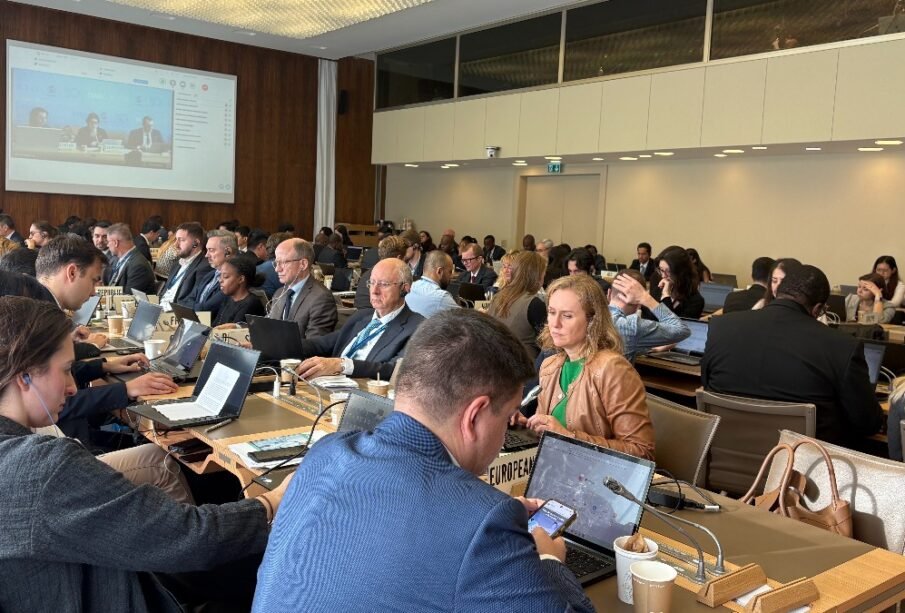
On 11 November, WTO members held three thematic sessions. The first was on “International Standards for Critical and Emerging Technologies”, the second on “Technical Assistance – the Role of Metrology in Facilitating Trade” and the third on “Good Regulatory Practices – Regulatory Impact Assessment and Trade-related Impacts”. The following day, they held an information session on non-tariff measures affecting information and communication technology (ICT) products under the WTO’s Information Technology Agreement.
International Standards for Critical and Emerging Technologies (CETs)
At the thematic session, speakers emphasized that international standards are essential for the development of AI, semiconductors and GPS technologies, among other CETs, by helping to enable innovation while supporting trustworthiness. Several WTO members refer to international standards on CETs when formulating their technical barriers to trade (TBT) measures to help promote regulatory coherence, avoid fragmentation and reduce compliance costs for the private sector.
Rapid technological innovation means CET standards need to keep pace with new developments, speakers said, stressing that the standards-development process should entail broader multi-stakeholder and interdisciplinary participation. Speakers called for enhancing capacity-building, regional cooperation and knowledge-sharing to enable developing members to fully participate in standardization activities.
More information – including a recording of the session – is available here.
Technical Assistance – the Role of Metrology in Facilitating Trade
Speakers emphasized at the thematic session that metrology helps provide confidence to all concerned that measurements are accurate, comparable and consistent across borders and over time. This reinforces assurance about the quality of goods, helps facilitate trade and promotes economic growth, speakers said.
Noting that 2025 marks the 150th anniversary of the Metre Convention, established to create a framework for international collaboration in metrology, speakers drew attention to the role international and regional cooperation play in strengthening the technical capabilities of national metrology institutes, including on emerging technologies and advanced materials.
The session highlighted the challenges developing and least-developed members face in building and maintaining metrology systems, such as limited technical and financial resources, inadequate infrastructure and a shortage of skilled personnel.
The recording of the session and background information is available here.
Good Regulatory Practices – Regulatory Impact Assessment and Trade-related Impacts
At this thematic session, members underscored the importance of mandatory and quality-controlled regulatory impact assessments (RIAs) to assess the impact of TBT measures on trade while also helping balance policy objectives and minimizing trade disruptions. If these assessments are undertaken early in the regulatory process, and with guidance, interagency review, public consultation, and assessment of regulatory and non-regulatory alternatives for proposed measures, they can support an effective and least trade-restrictive design for measures, speakers said.
Members also discussed challenges such as limited capacity and data gaps and underscored the value of gradual implementation, training and dialogue in addition to digital tools and AI.
More information – including a recording of the session – is available here.
Information Technology Agreement
In this cross-cutting session, WTO members explored possible synergies between the work of the TBT Committee and the Information Technology Agreement (ITA) Committee. They noted, for example, the benefits of the two committees sharing information to enhance members’ understanding of TBT matters in relation to information and communication technologies.
Specific trade concerns
In the Committee meeting, the United States reported the resolution of a trade concern it had raised on India’s Food Safety and Standards Amendment Regulations on alcoholic beverages and underscored the importance of open dialogue and cooperation.
The United Kingdom reported the resolution of a trade concern it had raised on Malaysia’s proposed amendments to a food regulation regarding alcoholic beverages and underlined the role of the TBT Committee in reducing unnecessary barriers to trade.
The list of the 70 trade concerns raised on members’ proposed and final TBT regulations is available here.
The 12 new trade concerns addressed a wide variety of regulatory issues related to cybersecurity, steel, tin, paper, food packaging, audio and video equipment, fertilizers, automobiles and cosmetics, among other things.
Transparency
The transparency guidance members adopted at the Committee meeting will assist members when they provide updates throughout the regulatory lifecycle of TBT measures. An example is when a notified draft measure is further amended or is adopted. The guidance also underscores that providing updates when extending deadlines for comments helps ensure every member benefits equally from the additional commenting time.
The guidelines were developed by the Transparency Working Group, established in 2022, to help advance the Committee’s work programme on transparency.
Cabo Verde announced at the meeting its first notification, in line with the guidelines adopted by the TBT Committee in March 2024. These relate to the notification of the legal and institutional arrangements members have put in place to implement the TBT Agreement. Cabo Verde is one of many members who have shared updates since the adoption of these guidelines.
The WTO Secretariat announced the availability of three new video tutorials and a new flyer to assist users in tracking members’ TBT measures via the ePing platform.
Technical assistance
Brazil – through its National Institute of Metrology, Quality and Technology (Inmetro) – provided an overview of current South-South cooperation on technical barriers to trade. The United States provided information on the new Global Information and Communications Technology and Critical and Emerging Technology Standards (GICS) Program, managed by the American National Standards Institute (ANSI).
The WTO Secretariat updated members on the 12 national and regional technical assistance activities delivered in 2025 in the TBT area. Nine in-person national and regional activities were held in Paraguay, Ecuador, Viet Nam, Chile, Ethiopia, Comoros, the Republic of Korea, Malaysia and Namibia. Three virtual ePing-specific clinics were also held for Myanmar, Guatemala and Comoros.
Side event
The United Kingdom, Barbados, Costa Rica and Canada co-hosted a side event, together with the UN’s Sanitation and Hygiene Fund (SHF), on safety standards on feminine hygiene products, discussing the lack of a global existing standard and current ongoing work at the International Organization for Standardization (ISO) to address this. The widespread use and potential health risks linked to high toxicity levels found in some products as well as access and affordability were some of the challenges highlighted.
Fuente: OMC